
Replacing kitchen doors can completely change the look of a kitchen without the cost and disruption of replacing the cabinets underneath. But before choosing colours, finishes or door styles, there is one practical question to get right:
What size replacement doors do you actually need?
For most kitchens, measuring replacement doors is straightforward. The important part is knowing what to measure, what not to assume, and which details can affect the final fit.
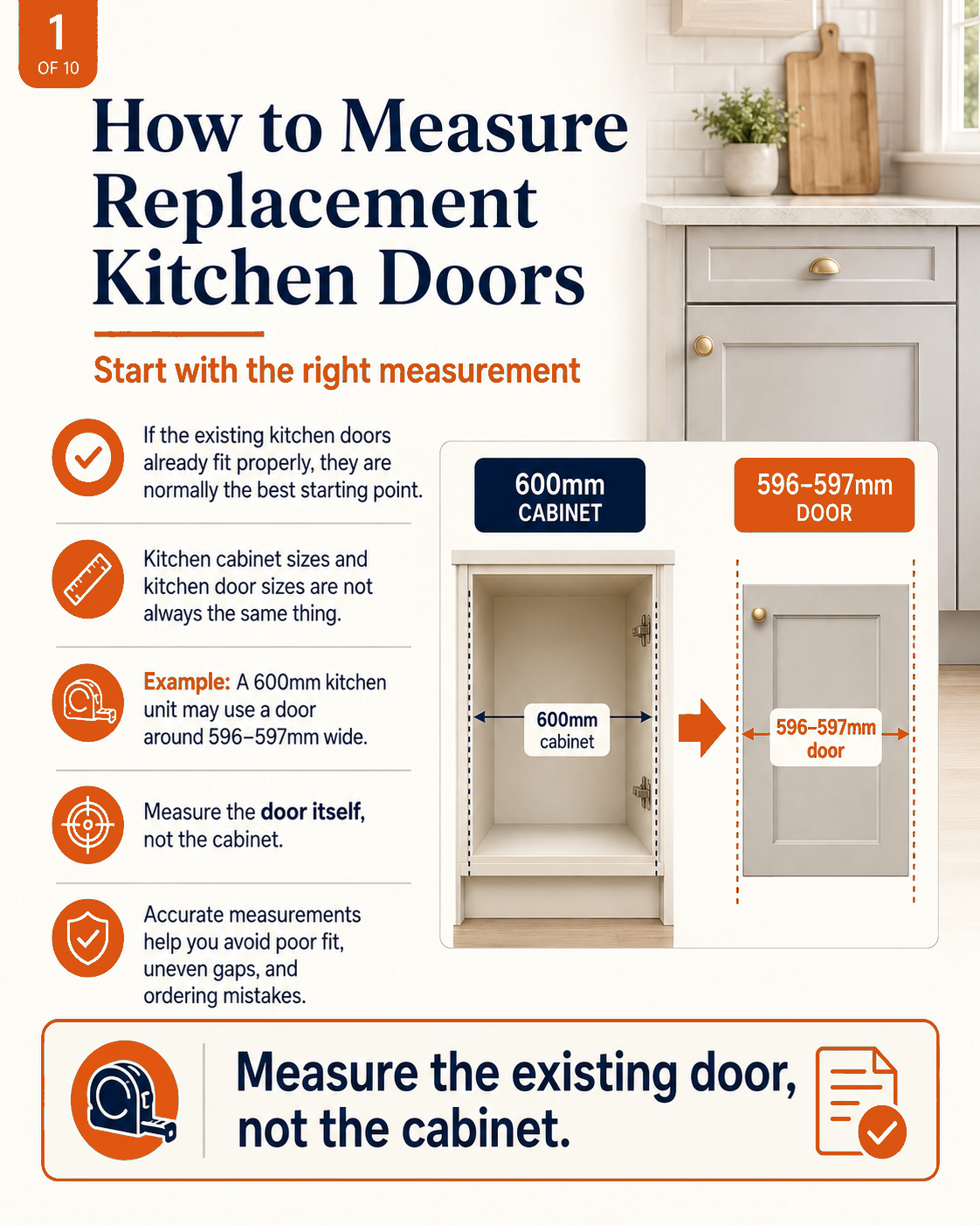
One of the most common points of confusion is that kitchen cabinet sizes and kitchen door sizes are not always the same thing. A 600mm kitchen unit, for example, will usually require a door slightly narrower than 600mm because the door needs clearance to open correctly.
That is why, when the existing kitchen doors already fit properly, they are normally the best starting point.
This guide explains how to measure replacement kitchen doors accurately, how standard kitchen door sizes work, what to look out for in older kitchens, and what to check before placing an order.
If you are still deciding whether replacing your doors is worthwhile, our guide to how much it costs to replace kitchen cupboard doors is a useful place to start.
The most important rule: measure the existing door, not the cabinet
If your existing door fits correctly, measure the door itself.
This sounds simple, but it avoids one of the easiest mistakes to make when ordering replacement kitchen doors.
Kitchen units are commonly described by their nominal cabinet width — 300mm, 400mm, 500mm or 600mm, for example. The door fitted to that cabinet is normally slightly smaller to leave the clearance needed between neighbouring doors and drawers.
So a cabinet described as 600mm wide may use a door around 596mm or 597mm wide.
That difference is intentional.
If you simply measure the cabinet and order a door to exactly the same width, the replacement may not open correctly or may leave the gaps between adjoining doors looking uneven.
Where a correctly fitting existing door is available, it has already done the hard work for you. It gives you the dimensions that work with your current kitchen.
Why kitchen door measurements matter
Replacement doors are not particularly complicated products, but they do rely on accuracy.
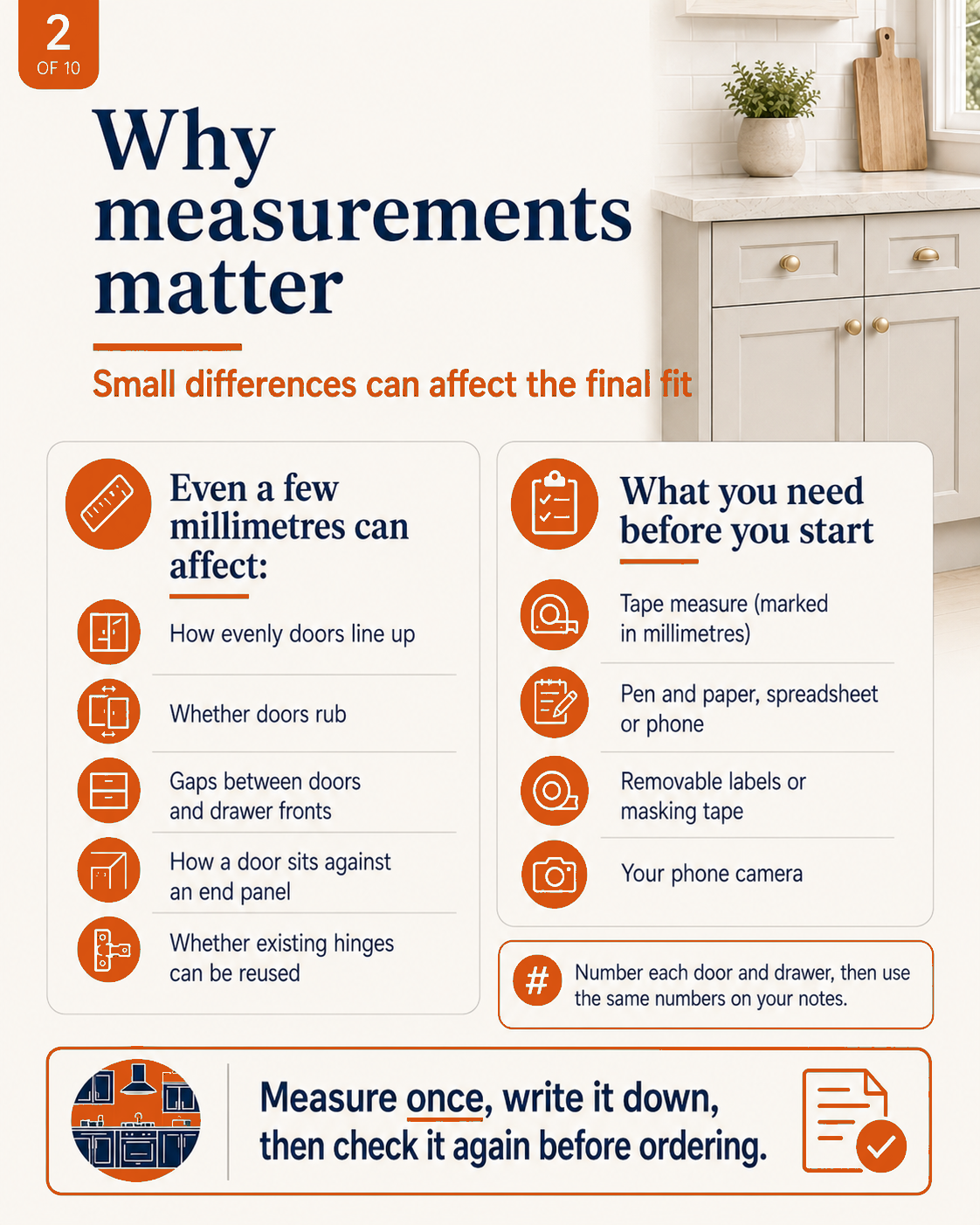
The gaps around kitchen doors are small. A difference of only a few millimetres may affect:
- how evenly neighbouring doors line up;
- whether two doors rub against each other;
- the gap between doors and drawer fronts;
- how a door sits against an end panel;
- whether the existing hinges can be reused comfortably.
The aim isn’t to make measuring sound difficult. It is simply worth taking your time.
A good rule is:
Measure once, write it down, then check it again before ordering.
That small extra step can prevent considerably more inconvenience later.
What you need before you start
You do not need specialist equipment.
A good tape measure showing millimetres clearly is usually enough, along with something to record your measurements.
We recommend having:
- a tape measure marked in millimetres;
- a pen and paper, spreadsheet or phone;
- removable labels or masking tape;
- your phone camera.
The camera can be surprisingly useful. If you have several similar doors, take a photograph of the kitchen and number each door before you begin.
For example:
Door 1 – sink base unit
Door 2 – drawer front
Door 3 – wall unit
Use the same numbers on your measurement sheet.
It makes the ordering process much easier once you are looking at a list containing ten or twenty different measurements.
How to measure replacement kitchen doors
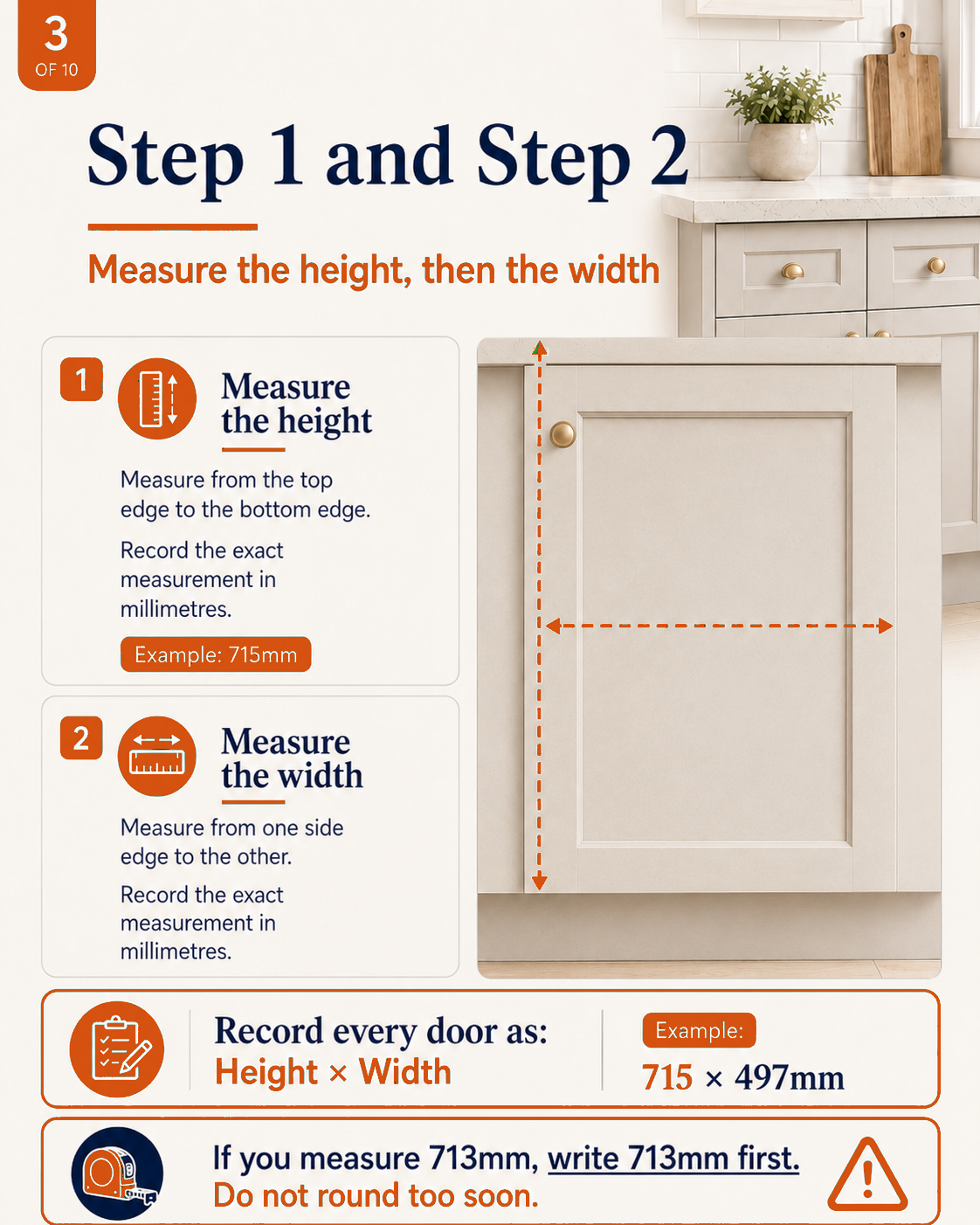
Step 1: Measure the height
Measure the existing door from its top edge to its bottom edge.
Record the measurement in millimetres.
For example:
715mm
Measure the actual door rather than assuming it must correspond to one of the common standard sizes.
If you measure 713mm, write down 713mm first. You can check the measurement again afterwards rather than immediately rounding it to 715mm.
Step 2: Measure the width
Measure across the door from one side edge to the other.
Again, record the exact measurement in millimetres.
We recommend recording every kitchen door as:
Height × Width
For example:
715 × 497mm
Using the same format throughout the kitchen reduces the risk of accidentally reversing the measurements later.
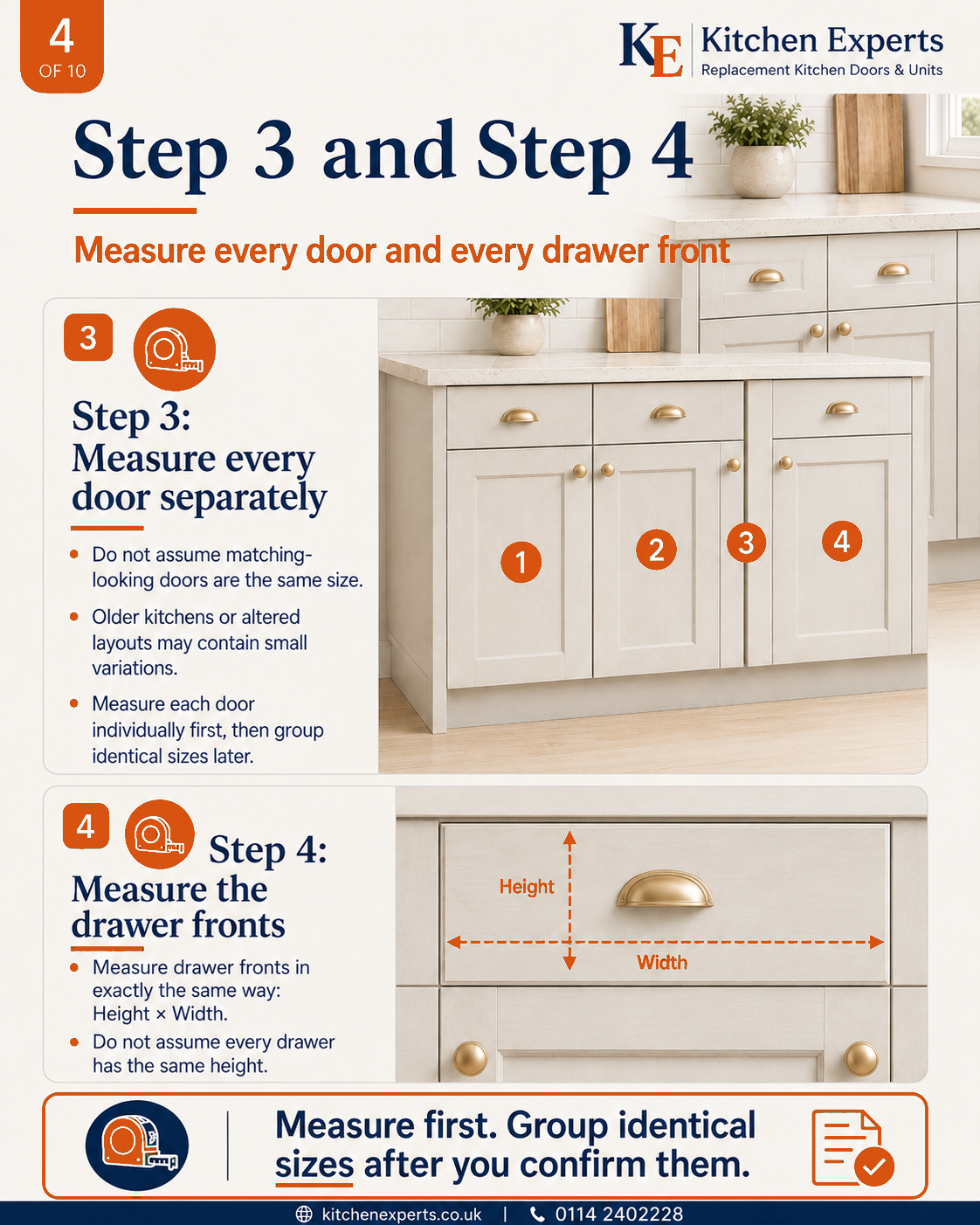
Step 3: Measure every door separately
If several kitchen doors look identical, it is tempting to measure one and assume the others are the same.
In a recently fitted kitchen from one range, they often will be.
But kitchens change over time.
A previous owner may have replaced one cabinet, added an appliance housing or altered part of the layout. Older kitchens can also contain small variations that are not obvious until the doors are measured.
Measure every door individually first.
Once you have confirmed that six doors are all 715 × 497mm, you can group them together on your final order.
Step 4: Measure the drawer fronts
Drawer fronts are measured in exactly the same way:
Height × Width
Do not assume every drawer within the same cabinet has the same height.
Some drawer configurations deliberately use different front sizes, particularly where a deep pan drawer sits underneath shallower drawers.
Record each one separately.
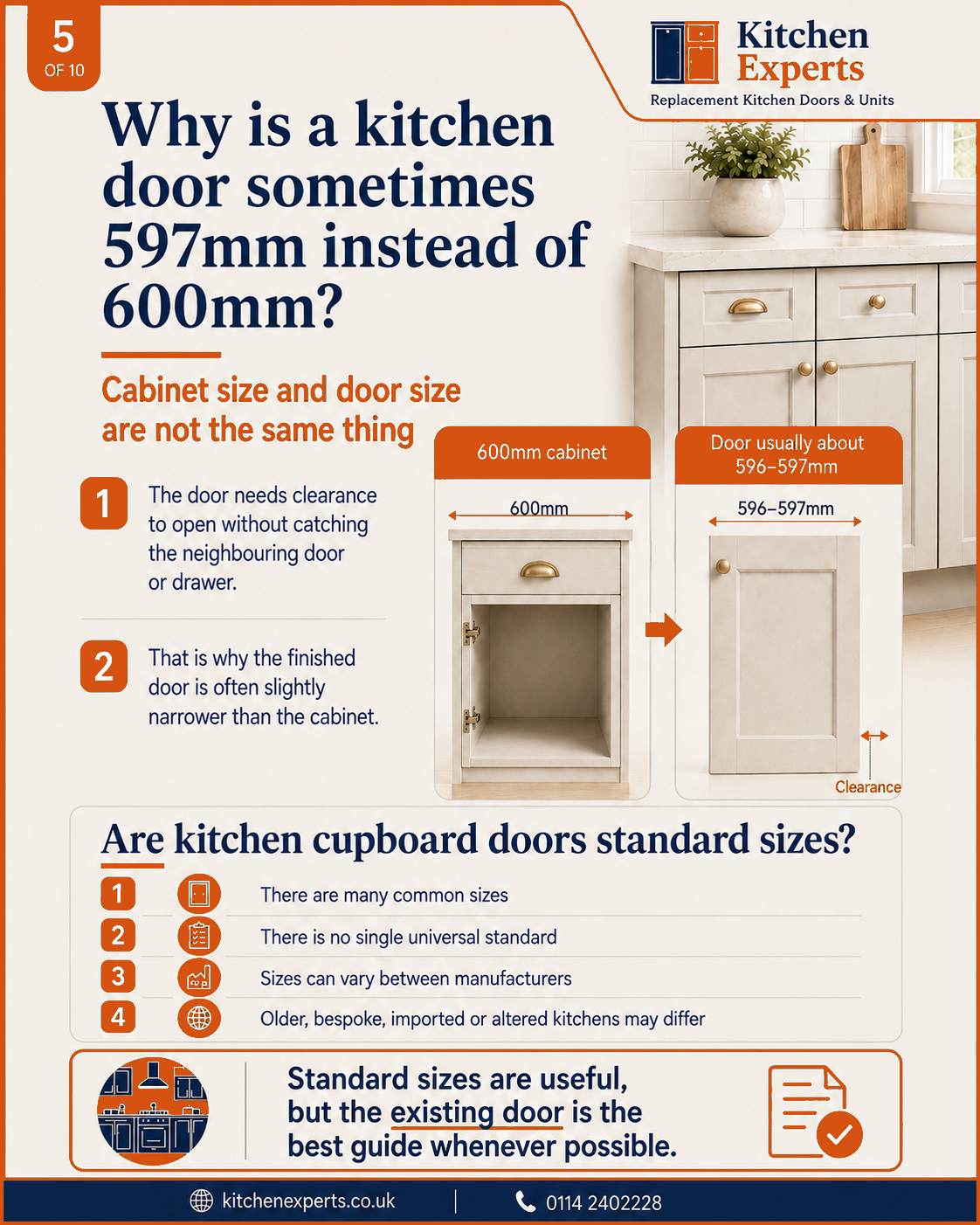
Why is a kitchen door sometimes 597mm instead of 600mm?
This is one of the questions that causes the most confusion when people first measure their kitchen.
You may know that you have a 600mm kitchen unit, then measure the door and discover it is only 597mm wide.
Nothing is necessarily wrong.
The cabinet size and door size describe two different things.
The cabinet may be 600mm wide, but the door needs a small amount of clearance around it so that it does not clash with the door next to it.
That is why replacement door ranges commonly include sizes just below the nominal cabinet width.
This is also why we would not recommend ordering replacement doors purely from the cabinet dimensions unless there is no existing door available to measure.
Are kitchen cupboard doors standard sizes?
There are certainly common kitchen door sizes, but there is no single universal standard used by every kitchen manufacturer.
Many kitchens are built around familiar cabinet widths, which means certain door sizes appear frequently.
However, there can be differences between:
- kitchen manufacturers;
- older and newer ranges;
- bespoke kitchens;
- imported cabinets;
- kitchens that have been altered after installation.
So standard sizes are useful for understanding what you are looking at, but they should not replace measuring the actual door.
Kitchen Experts supplies replacement kitchen doors across a wide selection of sizes, styles and finishes. If your measurements look slightly unusual, that does not automatically mean the complete cabinet needs replacing.
It is worth checking the available kitchen door ranges before assuming the size cannot be replaced.
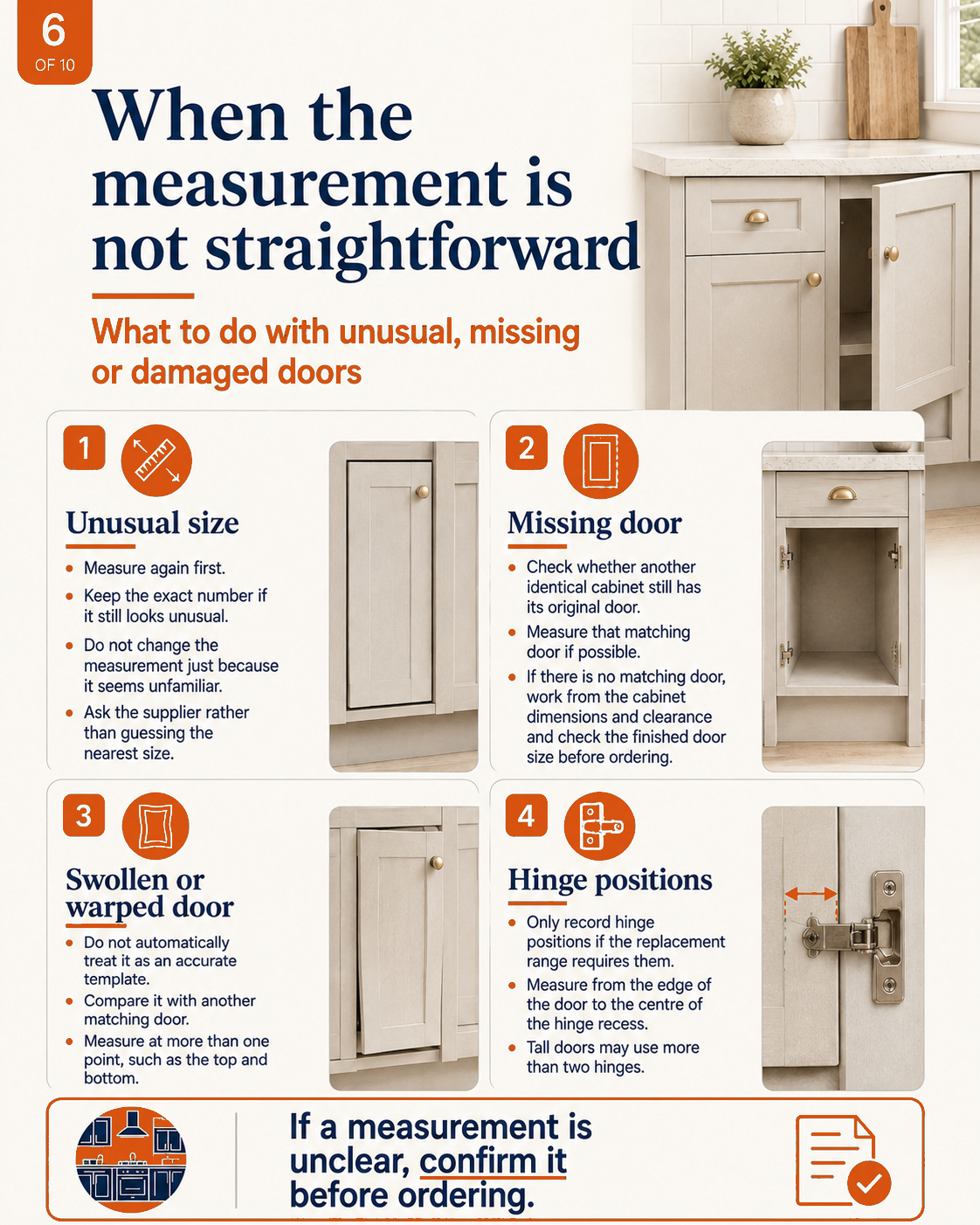
What if your kitchen doors are an unusual size?
An unusual measurement is not necessarily a problem.
The first thing we would recommend is measuring the door again.
Check:
- the height;
- the width;
- whether the tape measure was perfectly straight;
- whether the door itself is warped or damaged.
If the measurement is still unusual, look at another door fitted to the same size cabinet.
Older kitchens in particular do not always match the dimensions you might expect from a modern kitchen range.
The important thing is not to change the measurement simply because it looks unusual.
Confirm it first.
If you cannot find an appropriate size within the available replacement door ranges, that is the point to ask the supplier rather than guessing which nearby size might work.
What if the original kitchen door is missing?
This is one situation where measuring the cabinet may become necessary.
Before doing that, check whether another identical cabinet elsewhere in the kitchen still has its original door.
For example, if one 500mm base-unit door is missing but another identical unit remains, measure the existing door from that cabinet.
That will usually give you a better reference than calculating the size from the cabinet opening.
If there is no matching door available, you will need to work from the cabinet dimensions and the clearance around neighbouring doors.
At that point, we would recommend checking the required finished door size before ordering.
What if the existing door is swollen or warped?
Water damage, heat and general wear can change the shape of older kitchen doors.
A badly swollen door should not automatically be treated as an accurate template.
If one edge has expanded, compare it with another door of the same type elsewhere in the kitchen.
You can also measure the damaged door at more than one point.
For example, check the width across both the top and bottom.
If the measurements differ noticeably, the door may have distorted over time.
This is another situation where checking against another matching door or asking for advice is better than relying on a single measurement.
Do hinge positions need to be measured?
This depends on how the replacement doors are supplied and whether you intend to reuse the existing hinges.
If hinge holes need to correspond with your existing setup, their positions must be recorded accurately.
Where hinge measurements are required, you would normally measure from the edge of the door to the centre of the hinge recess, rather than to its nearest edge.
Tall doors may use more than two hinges, so each position needs to be accounted for.
However, hinge requirements can vary between door ranges and suppliers.
Before spending time recording every hinge position in the kitchen, check exactly what information is required for the doors you intend to order.
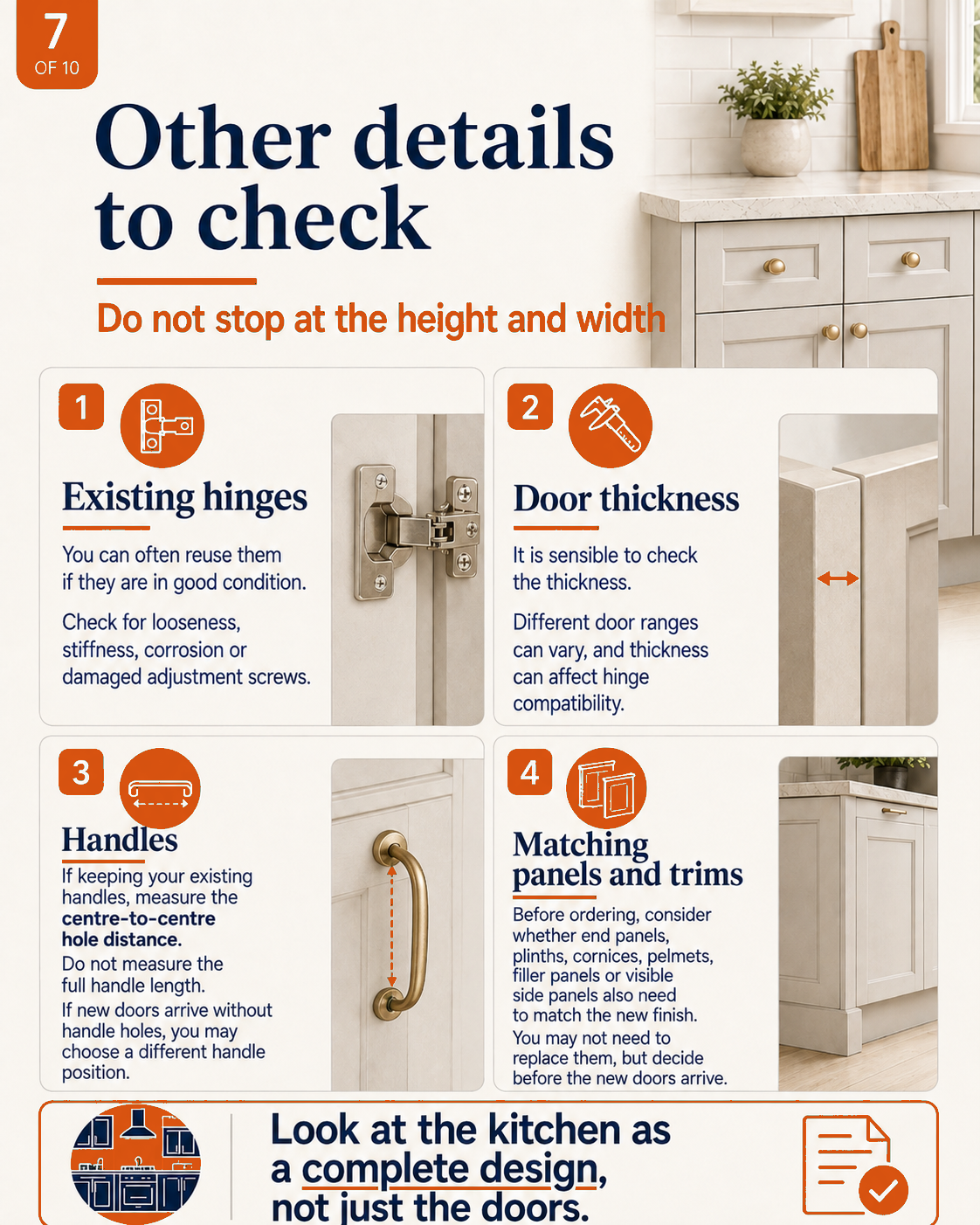
Should you reuse your existing hinges?
Often, yes.
If the existing hinges are in good condition and compatible with the replacement doors, there may be no reason to replace them.
But this is a useful moment to inspect them.
Look for hinges that:
- feel loose;
- no longer hold the door level;
- have become stiff;
- show corrosion;
- have damaged adjustment screws.
Replacing kitchen doors gives you the opportunity to correct small fitting problems that may have developed over the years rather than transferring them directly to the new doors.
Do you need to measure door thickness?
It is sensible to check it.
Different kitchen door ranges can use different materials and thicknesses.
Door thickness can influence how the door works with the existing hinges and how it sits alongside surrounding panels.
This does not mean the replacement door must always be exactly the same thickness as the existing one, but it is worth understanding the difference before ordering — particularly if you plan to reuse the original hinges.
What about handles?
If you are keeping your existing handles, check how they are currently fitted.
For handles with two fixing points, measure the distance from the centre of one screw hole to the centre of the other.
This is known as the centre-to-centre measurement.
Do not simply measure the full length of the handle.
If your new doors arrive without handle holes, you may also choose to reposition the handles completely.
That can work particularly well when the new door style is different from the old one.
For example, a handle position that suited a traditional raised-panel door may not be the position you prefer on a cleaner contemporary design.
Look beyond the doors before placing your order
Once you start replacing kitchen doors, another question often appears:
What else needs to match?
You may decide that your existing end panels, plinths or trims still work perfectly well.
But changing from one colour or finish to another can make older surrounding panels more noticeable.
Before ordering, take a few minutes to look at the kitchen as a complete design.
Check whether you also need to consider:
- end panels;
- plinths;
- cornices;
- pelmets;
- filler panels;
- visible side panels.
You do not necessarily need to replace them.
The point is to make the decision before the new doors arrive rather than afterwards.
Common measuring mistakes we would avoid
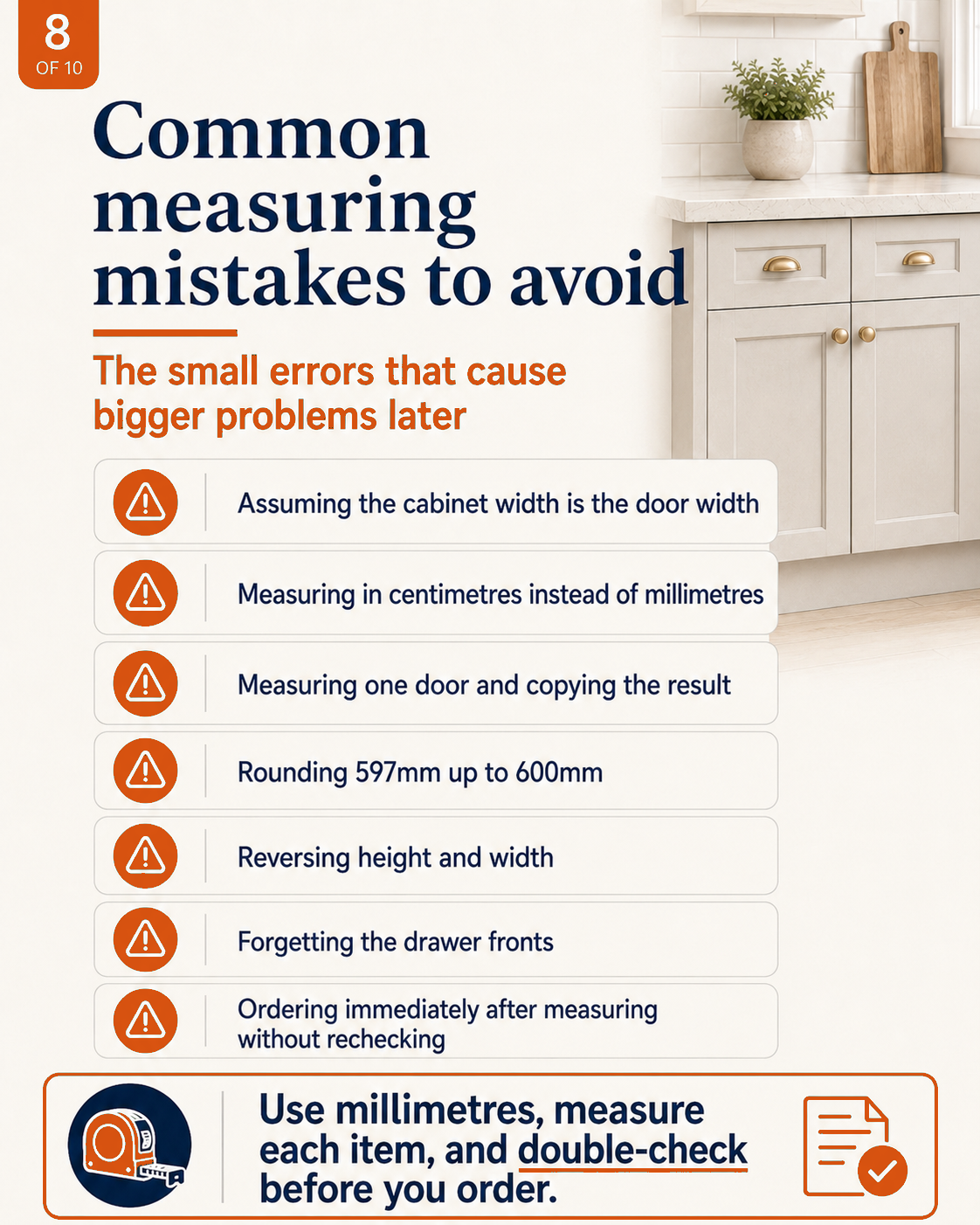
Assuming the cabinet width is the door width
A 600mm cabinet does not necessarily use a 600mm door.
Measure the door whenever possible.
Measuring in centimetres
Use millimetres throughout.
Kitchen doors require enough accuracy that millimetres are far easier to work with.
Measuring one door and copying the result
Confirm every door individually before grouping identical sizes together.
Rounding measurements
If a door measures 597mm, do not automatically change it to 600mm because 600 sounds more familiar.
The 3mm difference may be there for a reason.
Reversing height and width
Choose one format and stick to it.
We recommend:
Height × Width
Forgetting drawer fronts
A replacement-door project often includes more than doors.
Count and measure drawer fronts at the same time so they do not get missed from the order.
Ordering immediately after measuring
Check everything once more.
It takes far less time to confirm a measurement than to resolve an incorrect door after delivery.
Our recommended way to record your measurements
You do not need anything complicated.
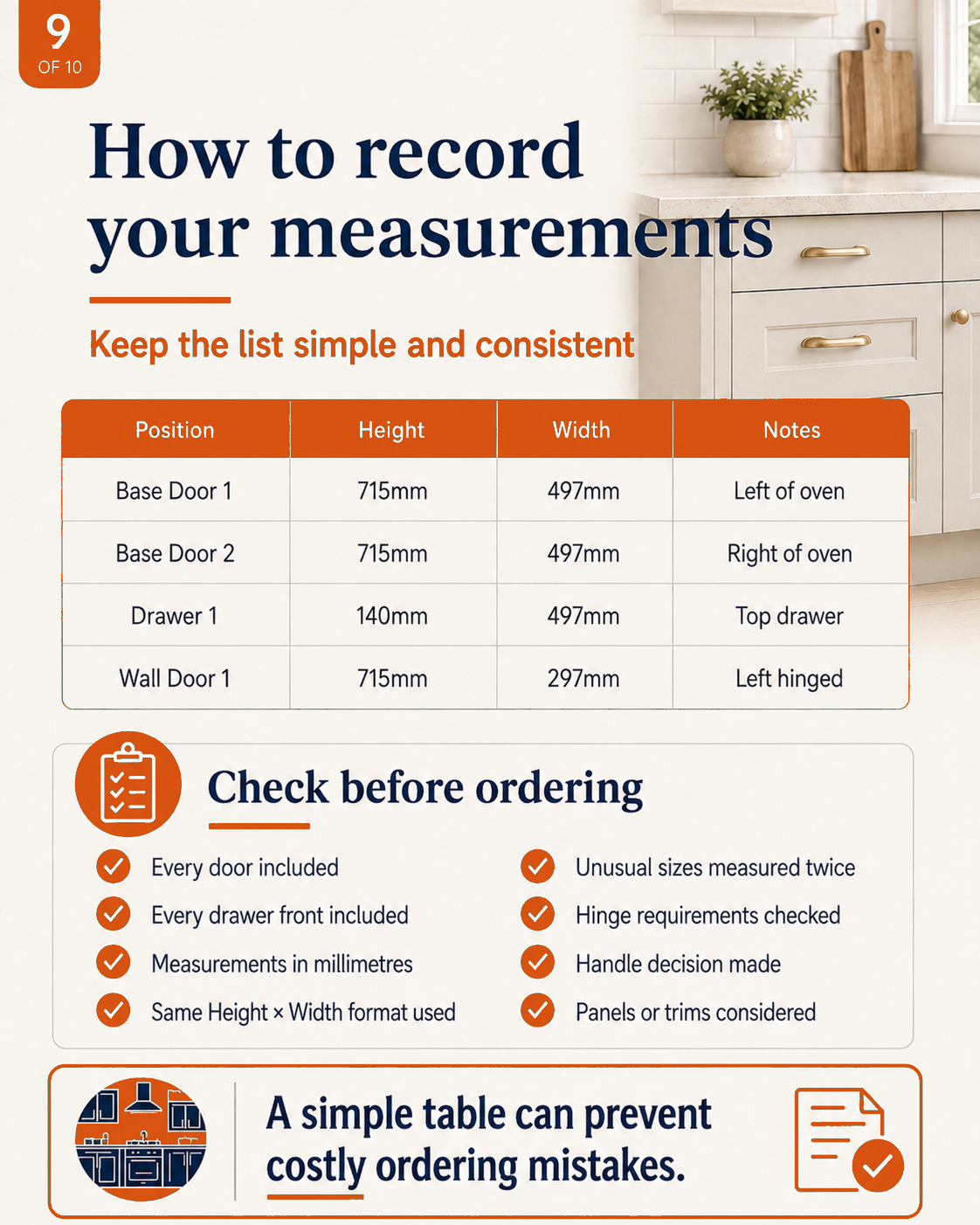
A simple table is enough:
| Position | Height | Width | Notes |
| Base Door 1 | 715mm | 497mm | Left of oven |
| Base Door 2 | 715mm | 497mm | Right of oven |
| Drawer 1 | 140mm | 497mm | Top drawer |
| Wall Door 1 | 715mm | 297mm | Left hinged |
If there are hinge details or other important notes, record them alongside the dimensions rather than trying to remember them later.
For a larger kitchen, take a photograph and mark the same door numbers onto it.
What should you check before ordering replacement kitchen doors?
Once you have finished measuring, do not rush straight to the checkout.
Take five minutes and work through the kitchen again.
Check:
- Every door has been included.
- Every drawer front has been included.
- Heights and widths are recorded in millimetres.
- Measurements use the same height × width format.
- Any unusual sizes have been measured twice.
- You have checked what is required for hinges.
- You have decided whether the existing handles will be reused.
- You have considered whether surrounding panels or trims need to match.
At this point, you should have a much clearer picture of what the replacement project actually requires.
You’ve measured your kitchen. What happens next?
Once the measurements are confirmed, the more enjoyable decisions begin.
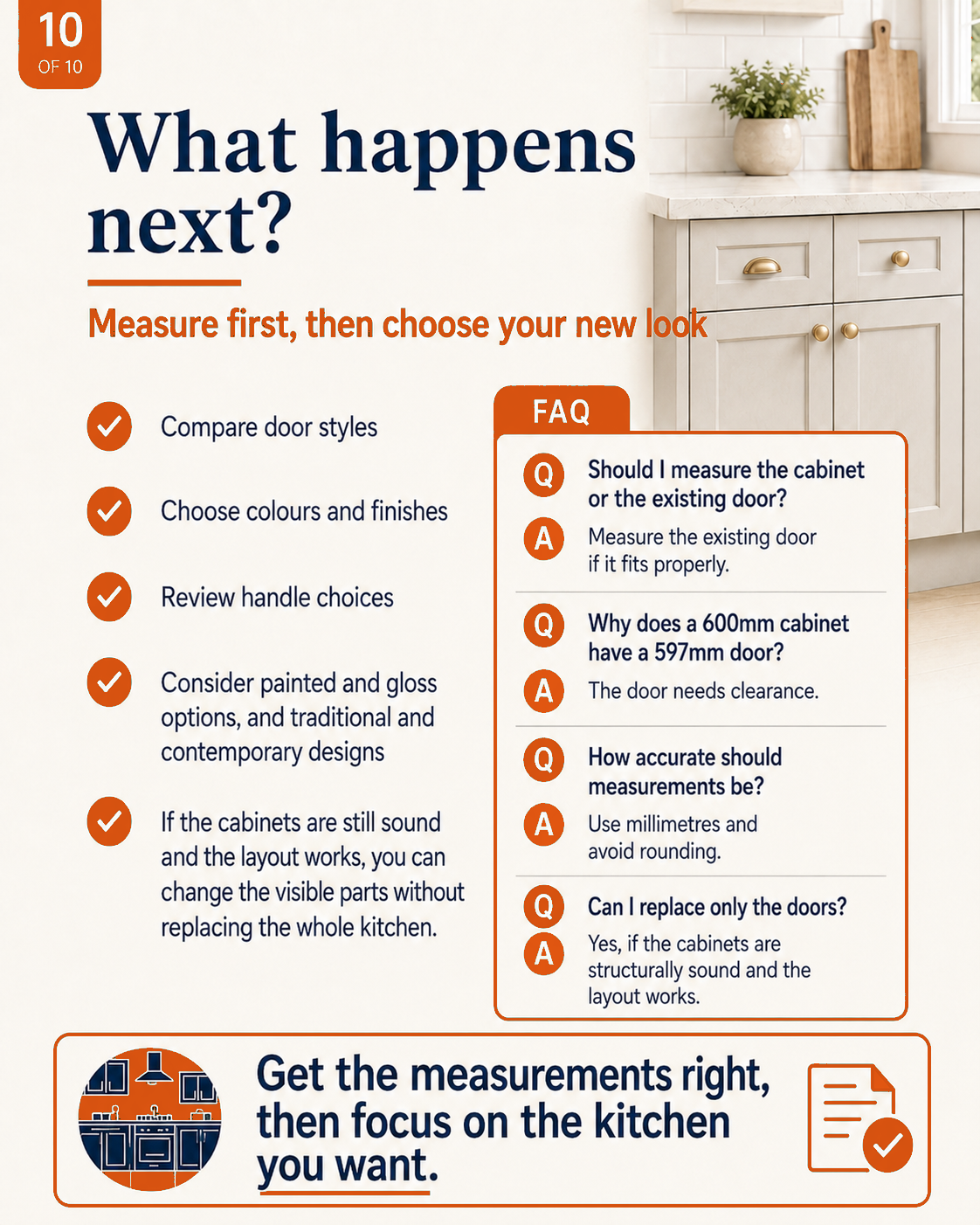
You can start comparing:
- door styles;
- colours;
- finishes;
- handle choices;
- painted and gloss options;
- traditional and contemporary designs.
This is where replacement kitchen doors offer a lot of flexibility.
If the existing cabinets are still strong and the layout works for you, you do not have to redesign the entire kitchen simply to change how it looks.
You can keep the parts that are working and concentrate the budget on the visible areas that make the biggest difference.
Browse the Kitchen Experts range of replacement kitchen doors to compare the available styles and sizes.
If you cannot find the measurement you need, or one of your doors does not seem to match a standard size, contact us before ordering. It is better to check an unusual measurement than guess.
Frequently asked questions
Should I measure the kitchen cabinet or the existing door?
If the existing door fits properly, measure the door itself. It already accounts for the clearance needed around the cabinet and is usually the most reliable reference for a replacement.
Why does my 600mm kitchen cabinet have a 597mm door?
The door needs a small clearance so that it can open without catching the neighbouring door or drawer. The nominal cabinet size and finished door size are therefore not always identical.
Are replacement kitchen doors standard sizes?
There are many commonly used kitchen door sizes, but dimensions vary between manufacturers and kitchen ranges. Older or modified kitchens can also use less common sizes, so measuring the existing door is always recommended.
How accurate should kitchen door measurements be?
Record measurements in millimetres and avoid rounding. Even a small difference can affect the gap between neighbouring doors.
What if I cannot find my exact kitchen door size?
Measure again first to make sure the dimensions are correct. If the size still does not appear within the available range, contact the supplier before choosing a different size.
Can I keep my existing kitchen cabinets and only replace the doors?
Yes, provided the cabinets are structurally sound and you are happy with the existing layout. Replacing doors can be a practical way to update the kitchen without replacing the entire installation.
Should I measure every kitchen door?
Yes. Even when several doors appear identical, confirm each measurement before grouping them together on your order.
Get the measurements right, then focus on the kitchen you want
Measuring replacement kitchen doors should not be intimidating.
For most kitchens, the existing doors provide the information you need. Measure carefully, work in millimetres, check unusual dimensions twice and avoid assuming that the cabinet size is automatically the same as the door size.
Once those details are confirmed, you can concentrate on the part that actually changes the kitchen — choosing the right doors, colours and finishes.
Explore the full range of Kitchen Experts replacement kitchen doors, or get in touch if you need help checking an unusual size before ordering.